When two books disagree enough, backing both sides returns more than it costs. At +110 and +105 the implied probabilities sum to less than one, which is a 3.73% return on turnover whichever side wins, provided both bets are accepted at those prices and both stand.
Free. No account and no subscription. Needs macOS 14 or later on a Mac with Apple silicon (M1 or later). 34.9 MB, notarised by Apple.
The maths is one line. The hard parts are the two nobody writes about.
The price may already be gone. Between the screen showing a quote and your bet landing sit the poll interval, the network and you. A quote that looks 10 seconds old on a feed running 5.4 seconds behind is really 15.4, and its chance of still being there is 84% rather than 89%. Miss one leg and you are not arbing, you are betting.
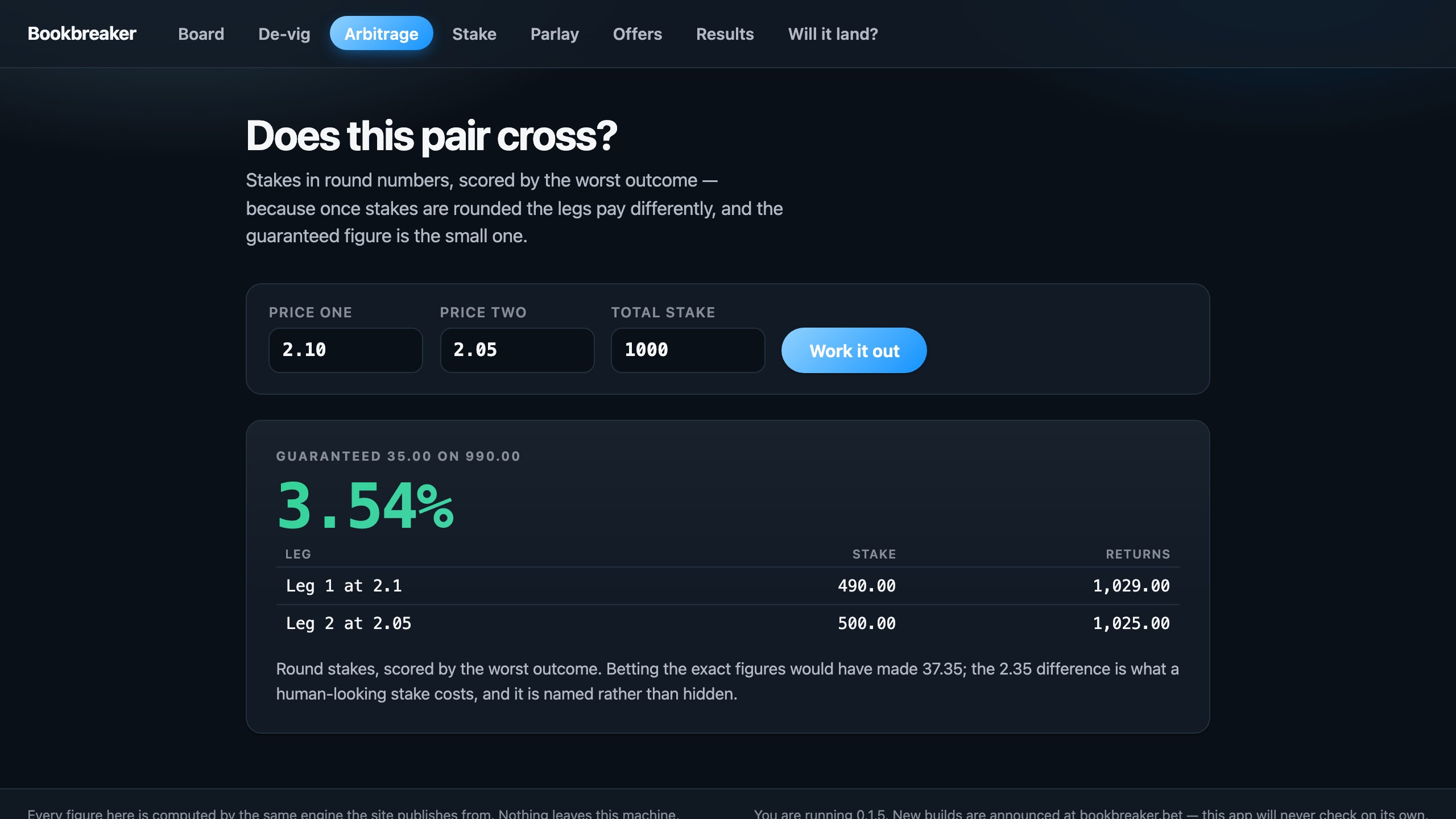
The exact stakes are awkward. The exact solution here is 493.98 and 506.02. Nobody types that. Rounding afterwards breaks the lock because the legs are not symmetric. Solving for round stakes directly gives 490 and 500, still locked if both bets are accepted and stand, for 2.35 of the 37.35. Stake one →
One arbitrage, start to finish
Find two books pricing the same market far enough apart that the implied probabilities add to less than a whole: here +110 at one and +105 at the other. Check both are the same market under the same rules. Work out the stakes for the total you want to put down, in round numbers. Place the leg more likely to move first, confirm it was accepted at the price, then place the second.
When the game settles, one book pays and the other keeps its stake. With 490 and 500 down, the worse of the two outcomes is 35.00 ahead.
What can go wrong
One leg is refused. The price moved, or the stake was over the limit. You hold one bet and either take the risk or cover it at whatever the other side now pays.
The two books settle by different rules. Whether overtime counts, what happens when a player does not start, how a tennis retirement is graded. If the rules differ, one result can lose both bets, or void one and leave the other standing.
A book voids a bet as an obvious error. A price far from the market is the kind books reserve the right to cancel. The other leg then stands alone.
The money is in two places. Every arbitrage needs funds sitting at both books before it appears, and withdrawals take time. The return on the money tied up is lower than the return on the bet.
The account gets limited. Books that take arbitrage action for long cut the stakes they accept from it. What a limit looks like →
Is it legal?
Placing bets at licensed books where you are allowed to bet is legal, and backing both sides breaks no law. What a book can do is limit the account or, under its terms, void a price it treats as an error. The locked figure always comes with the condition: both bets accepted at the prices shown, and both standing.