NewBookbreaker 0.1.6 is out — free, runs on your machine, nothing leaves it.Download it →
Free · Runs on your machine
Find your edge,
with the error bar.
Type any price, or pull live Kalshi and Polymarket markets with the
command-line tool. Knows which of 27 books take bets in
your state, devigs every price four ways, and every number carries what it
might be wrong by. Built to find bets and keep the account that places them.
The window as it ships, recorded — not a
mockup. Every number on screen is the engine's own answer to what is being
typed: the de-vig is a real 0.39% disagreement between
four methods, and the quote is aged from 4s to 100s so the fill falls with
it. The 5.4s of lag is fitted to
30 recorded observations; a fresh install
has none of your own yet and says so, starting from a stated prior and a
slightly kinder number until it does.
4Devig methods, side by side
0.39%Spread they disagree by
84%Fill on a 10s quote
0Bytes sent anywhere
Prices 27 sportsbooks across
50 states
Bally Bet
BetFred
BetMGM
BetRivers
Betfair Exchange
Betly
Betr
Caesars
Circa Sports
DraftKings
FanDuel
Fanatics
Hard Rock Bet
Kalshi
Pinnacle
Polymarket
Prime Sportsbook
ProphetX
Sports Bet Montana
Sportsbook Rhode Island
Sporttrade
SuperBook
Underdog Sports
WynnBET
bet365
betPARX
theScore Bet
Try it — nothing to install, nothing to sign up for
Drag the price older. Watch the edge go.
A 4.0% edge on the screen is not a 4.0% edge in
your account. It is that number multiplied by the chance the price is still
there when your bet lands — and no competitor's marketing mentions the
second half.
3.87%Edge you actually collect
96.7%Chance it is still there
88Stake on a 10,000 bankroll
screen says 4.0%
Survival is modelled as exponential with a
60-second mean lifetime and a 2-second floor
under the age — both stated priors until your own accept-and-reject
record replaces them. Every figure above is computed by the engine when
this page is built; the slider looks them up rather than recomputing
them.
What every other tracker prints
05.91%
What Bookbreaker prints
-7.0%0+18.9%
Try it on your own price
Type the two sides of any market. You get the consensus
fair probability and how far the four methods disagree about it — the
number a one-figure no-vig calculator leaves out.
Loading the engine’s answers…
Every answer here was computed by the same engine that
built this page, for all 6,737 two-way markets between −600 and
+600. Nothing is calculated in your browser: a second implementation
drifts from the first, and the drift is invisible until someone bets on it.
Prices that do not form a real two-way market are refused rather than
rounded into one.
The other three tabs, doing the work
Not screenshots of a design. Screenshots of the answer.
Every figure in these three was computed by the
engine while the shot was taken, and each was only captured once the
panel's output agreed with the input that produced it.
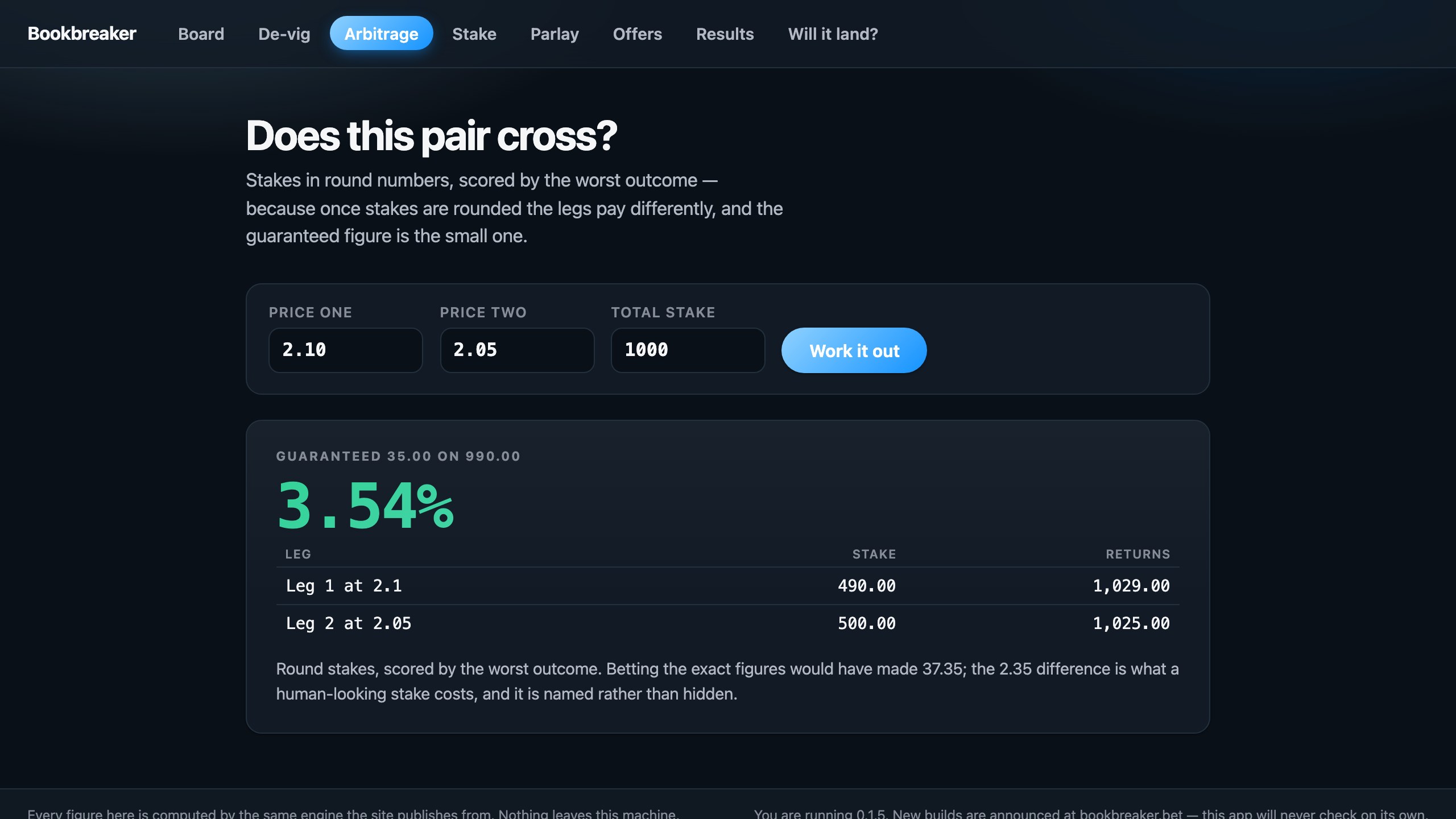
Arbitrage2.10 against
2.05 — 3.54%
either way, with the stake on each leg already rounded to something a
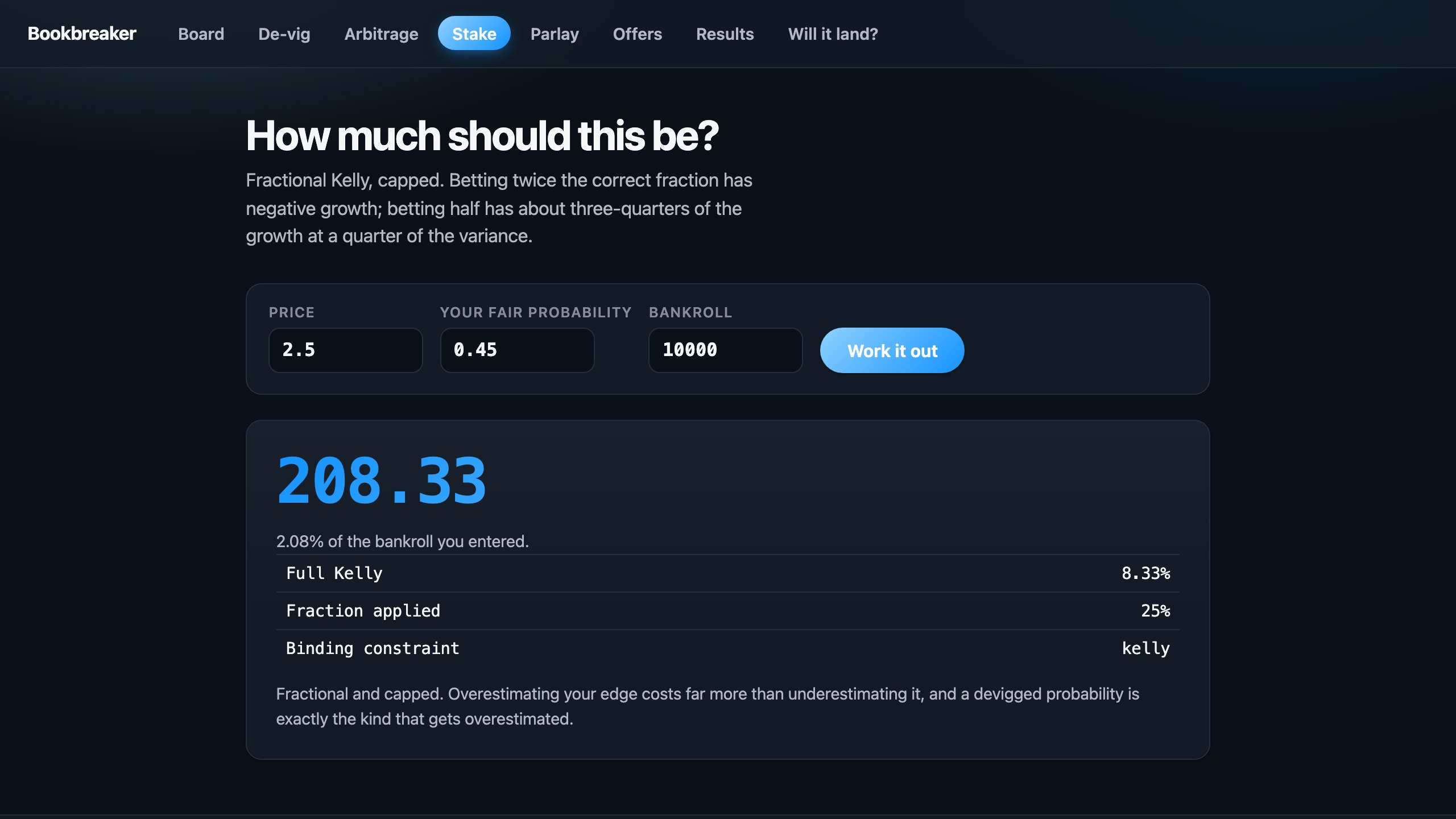
book will actually accept.StakeFull Kelly says
8.33% of the bankroll. The
25% fraction it recommends says
2.08% — and it names the
constraint that bound it rather than printing a number and leaving you
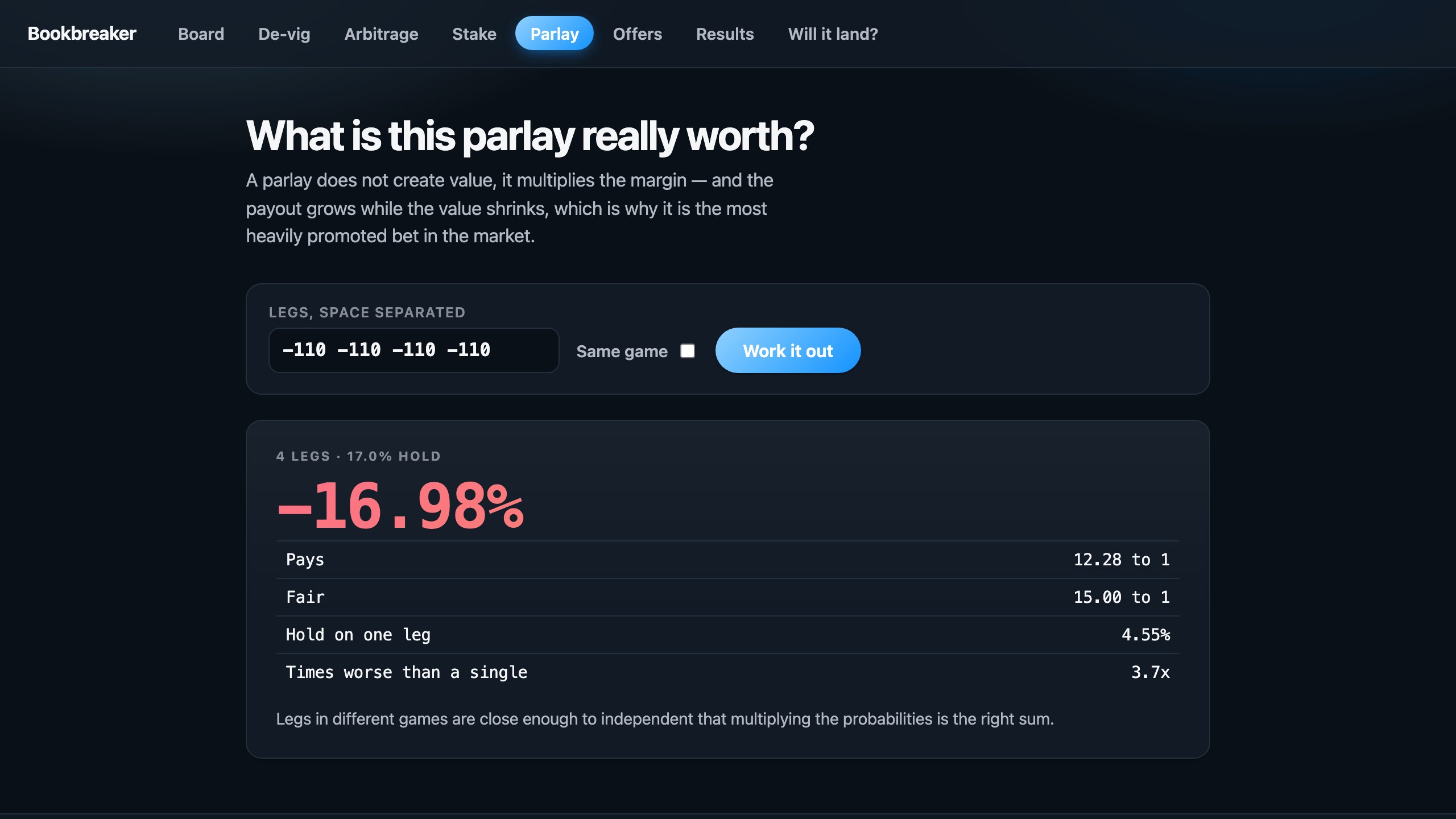
to trust it.Parlay4 legs at
−110 pay 12.28 to 1 where fair is
15.00 to 1, against
4.55% hold on a single leg — the
number the bet slip never shows you.
You do not have to take our word for any of it
Bookbreaker is new and has no customers to quote at
you, so this page has no testimonials. What it has instead is a list of
claims a stranger can check without trusting us at all — which is the
stronger thing to offer about software you are going to place money
alongside.
The download matches its published checksum.The build we notarised has SHA-256
ca56d69e1e235b93… and the full digest is
on the download page. Run
shasum -a 256 Bookbreaker-0.1.6.dmg and
compare. If it differs, do not open it.
Apple has notarised it, and your Mac will say so.Run
spctl -a -t open --context context:primary-signature -vv
against the file. It should say accepted and
source=Notarized Developer ID. That is Apple confirming the
binary, not us.
No network calls unless you turn on the live board. Your record never leaves your Mac.The app has no updater, no telemetry, no account and no sync —
0 bytes leave your machine, and
0 accounts exist to create. Point Little Snitch
or lsof -i -p $(pgrep Bookbreaker) at it and watch nothing
happen. The command-line live board, if you run it, requests public Kalshi and Polymarket prices and sends nothing about you. A test in the repo fails the build if the app window ever links a network library.
Every figure on this site was computed by the app you download.Not typed. The build runs the same engine —
40 modules, 46 test
files — and refuses to publish a number that engine did not
produce. That is why the fill figure here and the one in a fresh install
differ, and why the page says which is which.
Every legal claim carries its source and the date we read it.29 regulator and statute links across the
state pages, each with a read date, each checked by the build. A dead
citation fails the build rather than sitting there looking official.
What it will never do, including the profitable things
A tool for money is defined as much by its refusals.
These are ours, and they are enforced in code rather than promised in a
policy page.
Never asks for a sportsbook login.Competitors sync your
accounts with your credentials. We import a CSV or read a pasted
betslip. Same ledger, and your passwords stay yours.
Never touches identity, KYC, device or location.The
account-longevity model reads stake, timing, market and velocity —
bet shape, nothing else. It has no access to who you are and never
will.
Never places a bet for you.Automated placement needs your
logins and has to look human to the book. It is the fastest known route
to being limited, which is the opposite of the point.
Never publishes a number it did not measure.Where a
figure is a stated prior rather than something observed, the page says
so in the same sentence. The build fails if it does not.
Four things it shows you
Same market, four defensible methods
Removing a book's margin to recover what it really believes is a
modelling choice, not arithmetic. On a -145 / +125 moneyline the four
standard methods disagree by 0.39 points of probability.
A devigger that reports one fair price has picked one of these rows. Bookbreaker shows all four, and how far apart they are.
Method
Fair probability
additive
57.37%
multiplicative
57.11%
power
57.50%
shin
57.37%
Consensus 57.34%. On a market where a
2% edge is a good day, that spread is a quarter of the edge.
A stake a person would actually place
At +110 and +105 there is a
3.73% arbitrage. A precise stake to the cent is the
most-cited fingerprint risk desks use to identify arbitrage.
The 2.35 difference is named
and reported, not hidden. A tool that conceals its own trade-offs is not
one you can check.
Every calculator
493.98 / 506.02
37.35 locked if both stand
Bookbreaker
490 / 500
35.00 locked if both stand
An edge you cannot take is worth nothing
Quote age is measured from the book's own timestamp, not from when the
feed reached us. On a feed running 5.4 seconds behind, a
quote that looks 10 seconds old is really
15.4.
A screen that ignores its own latency reports a
fill it cannot deliver.
Screen ignoring latency
89%
claimed still available
Measured
84%
actually still available
What your record actually says
On a 220-bet history showing +1,300 profit and
5.91% return, most trackers print the return and stop.
The interval is the answer. A number without one is
a claim about a sample, dressed as a claim about you.
+5.91% flat-bet ROI, but the interval spans zero (-7.0% to +18.9%) — indistinguishable from break-even
From a price on screen to a decision
The bet you place late is a different bet
A quote you take 15.4s after it was
posted is worth 3.37% of a 4%
edge, not 4%. Everything in the window is built around
getting you to an answer before that decay eats it.
Open it
No account, no login, no sync. It runs offline, so there is no
round trip between you and an answer.
Type the price
Every field is already filled with a worked example, so you can see
the shape of the answer before you have typed anything. Replace the
numbers that differ.
Press Enter
Enter runs the tab you are in. Reaching for the mouse to submit a
four-character form is the slowest part of a fast decision.
Check it is still there
The fifth tab prices the quote's age against the book's own latency
and tells you the chance it fills — 84% on a
10s quote, against the 89% a
screen that ignores its own lag would show you.
And the account still has to be there tomorrow
An edge you get limited out of is a hobby
Risk desks do not read your intentions. They read the shape of your
betting: how precise the stakes are, which markets you pick, how fast you
react. Bookbreaker scores that shape and spends a named amount of edge to
soften it.
What it will never do: no
multi-accounting, no identity or KYC workarounds, no device or location
spoofing. The model reads bet attributes only — stake, timing,
market, velocity — and has no access to identity or network state.
That line is drawn in the code, not in a policy page.
Edge hides where attention does not go, which
is exactly what makes it visible.
Reaction time
99% at
0.5s
5% at
120s
No human refreshes and decides in half a
second.
Where it does nothing at all
At a book that does not limit winners, the stake is left alone:
473.82 stands, where a retail book would see
470. Spending edge to hide from a risk desk that does
not exist is the most common way these tactics are applied wrongly.
Download it and price one market
Free, 8.2 MB, no account, and it never talks to
us. If the first market you run through it does not tell you something your
current tool did not, you have lost ninety seconds.