Kelly criterion calculator
Kelly sizes a bet from your edge and the price: the share of your bankroll to bet is the edge divided by what the price pays per unit. Most bettors stake a fraction of that, such as a quarter, because an overestimated edge costs far more than an underestimated one.
Size your own bet
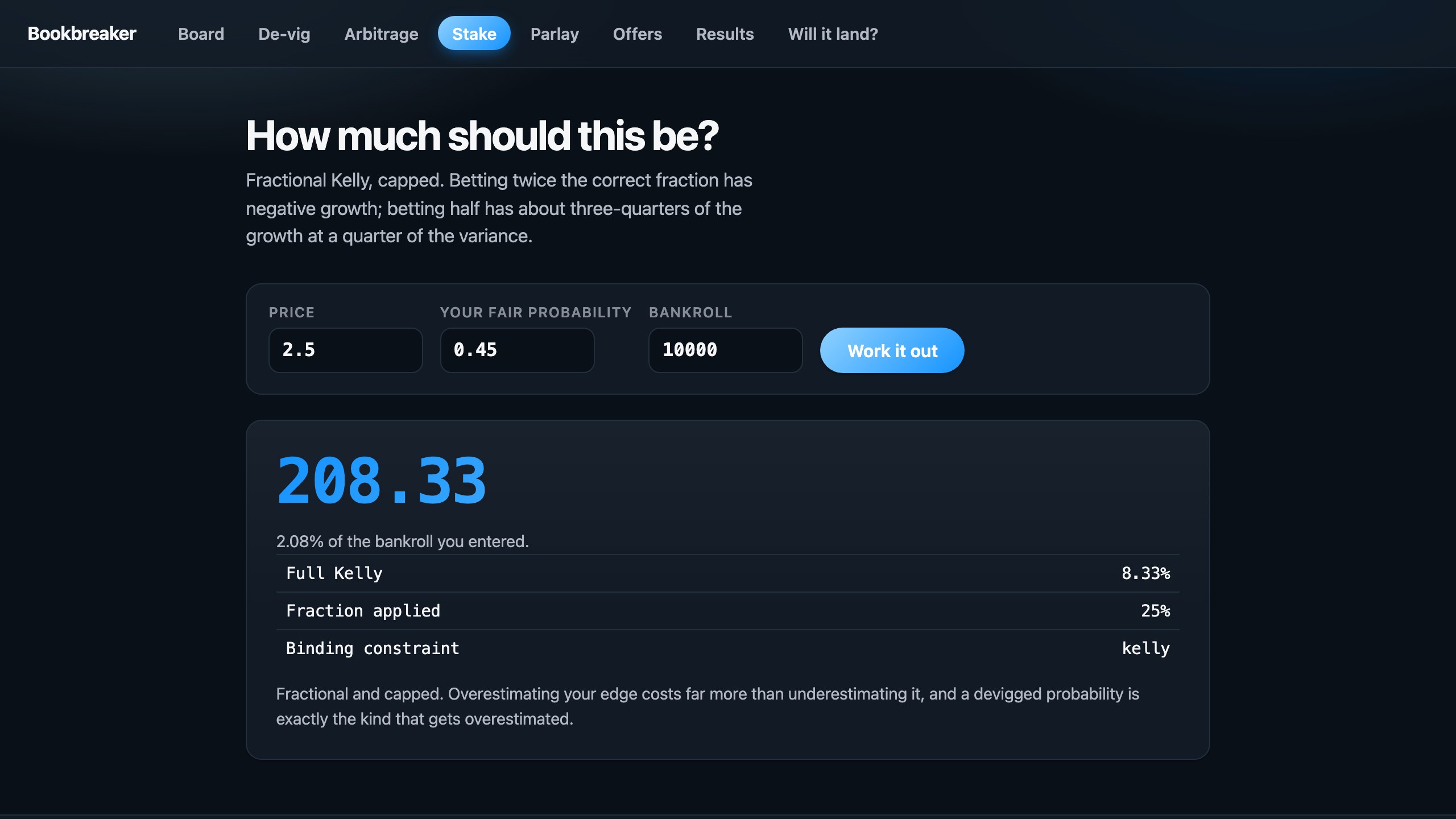
Give the price, the chance you think it wins and your bankroll. You get the Kelly stake, and which limit set it.
A 57.34% shot offered at +120, on a 10,000 bankroll:
| Full Kelly | 21.79% of bankroll |
| At quarter Kelly | 500.00 |
| Share of bankroll | 5.00% |
| Binding constraint | max_single |
Quarter Kelly, and sized on the least favourable devig rather than the friendliest. Overestimating an edge costs far more than underestimating it.
The Kelly fraction, worked
Kelly stakes the edge over the odds. At +120 the net odds are 1.20 to one. With a fair probability of 0.5734, the edge is 1.20 times 0.5734 less 0.4266, which is 0.2615. Divided by 1.20, that is 21.79% of the bankroll.
Quarter Kelly takes a quarter of that, 5.45%, or 545 on 10,000. The engine stakes 500.00 instead, because a cap on any single bet of 5.00% of the bankroll binds first. That cap is the binding constraint in the table.
Full Kelly grows a bankroll fastest only when the probability is exactly right. Get it a little high and full Kelly overbets; fractions of it give up some growth for a much smaller swing.
When to size with Kelly
When you have a fair probability you trust, from a devigged sharp market, and a price that beats it. Without the first, Kelly sizes a guess.
When you bet many times from one bankroll and want the stake to shrink after losses and grow after wins.
Check the bet is worth taking first: the expected value calculator uses the same inputs.
Free. No account and no subscription. Needs macOS 14 or later on a Mac with Apple silicon (M1 or later). 34.9 MB, notarised by Apple.
Where the number comes from
The worked example was computed by the same engine that prices bets, at the moment this page was built. None of it was typed in. The build fails if a figure appears here and not in the engine's own output. The calculator runs that engine, release 0.1.62, in your browser, and the build checks that it returns this example’s answers for this example’s inputs.