No-vig odds calculator
The true odds are the book's prices with its margin taken out. Turn each side's price into an implied chance, then scale the chances so they add up to exactly one. Different methods of removing the margin give slightly different answers, so this page shows all four and how far apart they are.
Try it on your own price
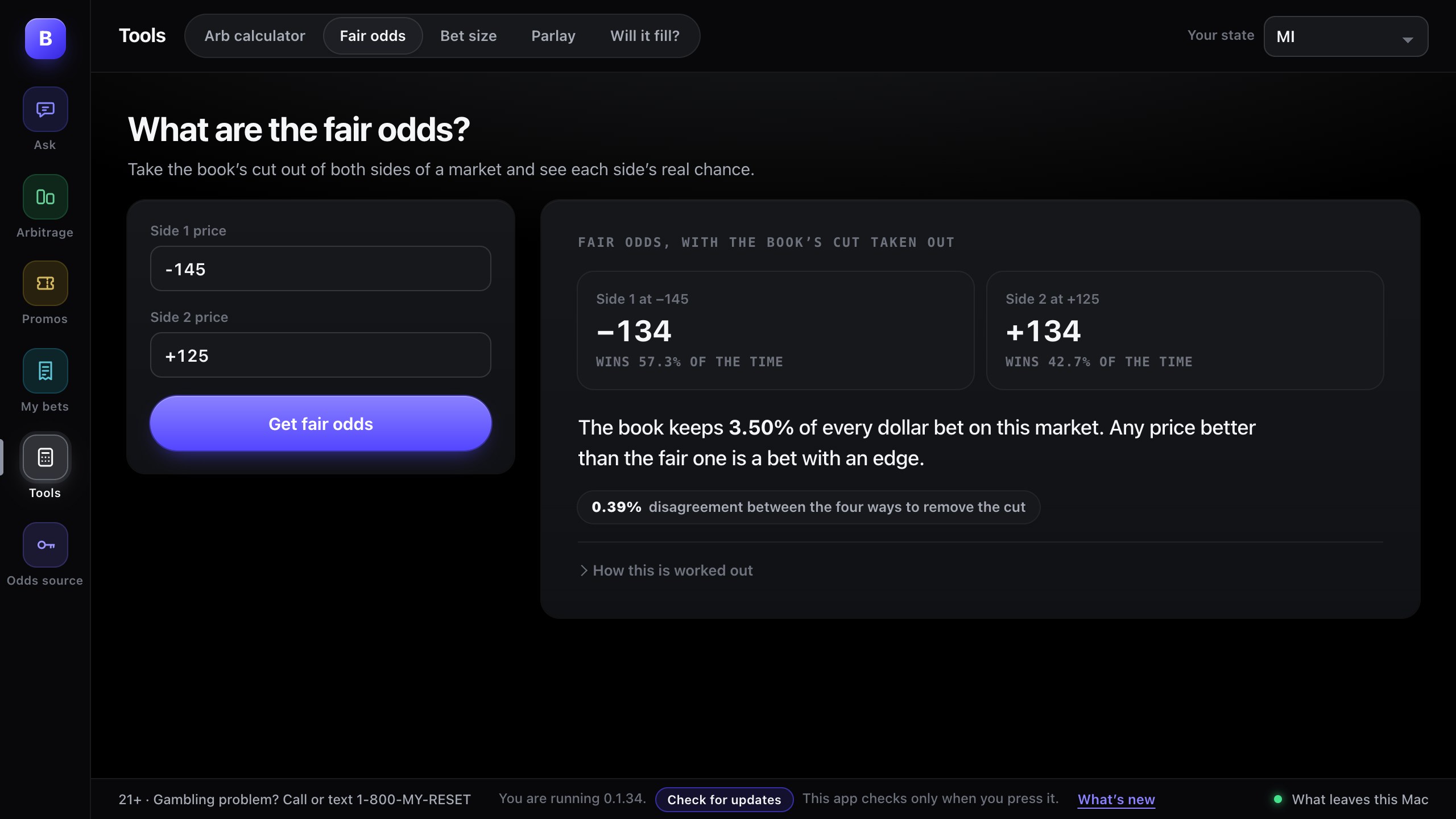
Type the two sides of a market priced in steps of 5, like −145 and +125. You get the consensus fair probability and how far the four methods disagree about it. A one-figure no-vig calculator leaves that number out.
Loading the engine’s answers…
Every answer here was computed by the same engine that built this page, for all 6,737 two-way markets between −600 and +600 in steps of 5. Nothing is calculated in your browser: a second implementation drifts from the first, and the drift is invisible until someone bets on it. A price off that grid, such as −112, is refused rather than rounded to the nearest one, and so is a pair that does not form a real two-way market. The no-vig calculator runs the engine itself on any price.
Any price, American or decimal
Type both sides of one market at any price, American or decimal, including prices like −112 that the box above does not hold. The engine runs in your browser and gives the fair probability under each of the four methods.
A book offering -145 / +125 is asserting probabilities that sum to more than one. Removing that margin gives the favourite:
| additive | 57.37% |
| multiplicative | 57.11% |
| power | 57.50% |
| shin | 57.37% |
Consensus 57.34%, and the four methods disagree by 0.39 points. A calculator that returns one number has picked one of them without saying which.
Taking the margin out by hand
The favourite at -145 is 1.6897 in decimal and implies 59.18%. The other side at +125 is 2.2500 and implies 44.44%. Together that is 103.63%; the 3.63% over a whole is the margin.
The multiplicative method scales each side down by the total: 59.18% over 1.0363 is 57.11%. The additive method takes an equal share of the excess off each side instead: 59.18% less half of 3.63% is 57.37%. Power and Shin lean the cut toward the longshot, where books tend to take more.
The consensus of the four, 57.34%, is a fair decimal price of 1.744, or -134. A book offering the favourite at better than that is paying above fair; one offering worse is charging for it.
When to devig
Before judging any price as good or bad. Raw implied probabilities include the margin and make every bet look worse, or a soft price look like an edge it is not.
On a sharp book's market, to get the fair probability that the expected value and Kelly calculators need.
When the four methods disagree by more than the edge you think you have. Then the edge is a matter of method, not of price.
Free. No account and no subscription. Needs macOS 14 or later on a Mac with Apple silicon (M1 or later). 34.9 MB, notarised by Apple.
Where the number comes from
The worked example was computed by the same engine that prices bets, at the moment this page was built. None of it was typed in. The build fails if a figure appears here and not in the engine's own output. The calculator runs that engine, release 0.1.62, in your browser, and the build checks that it returns this example’s answers for this example’s inputs.